Dump and Draw: Beginner Strategy for Dompe
Play money only. No prizes. 18+ only.
Dompe looks simple: draw a card, dump a card, and be the first to hold a winning six-card hand. The skill is in choosing what to keep. These tips are for new players, and they apply to every table. Everything here is for play-money chips, so use the practice tables to try them out.
1. Decide what you are building, and stay flexible
Look at the five cards you start with and ask which winning hand they are closest to. Pairs lead toward three pair or El Comi. Five cards of one suit lead toward a flush. Four or five ranks in a row lead toward a straight. Do not lock in too early: if the next card changes the picture, change your plan.
2. Watch the dump pile
You can take the exact card the previous player just dumped, so every dump tells you something. If someone dumps a card you need, you can take it. A player who dumps a seven is probably not building around sevens, so you can guess a little about what they are holding. Remember the cards you have seen go by: dumped cards are not coming from the deck again until a reshuffle.
3. Keep the Joker, and keep your pairs
The Joker is wild and fills any gap, so keep it. Pairs are the most flexible cards you can hold, because they fit both three pair and El Comi, and three pair is by far the most common winning hand. Read how the Joker works and the odds behind each hand to see why.
4. Dump the card that helps you least
Each turn you hold six cards and dump one. Dump the card that fits the fewest of the hands you are chasing. If you are holding a pair, two near-straight cards and a lone card of another suit, the lone card is usually the one to go. When two cards seem equally useless, dump the one that would help the next player least.
5. Spend your one bet carefully
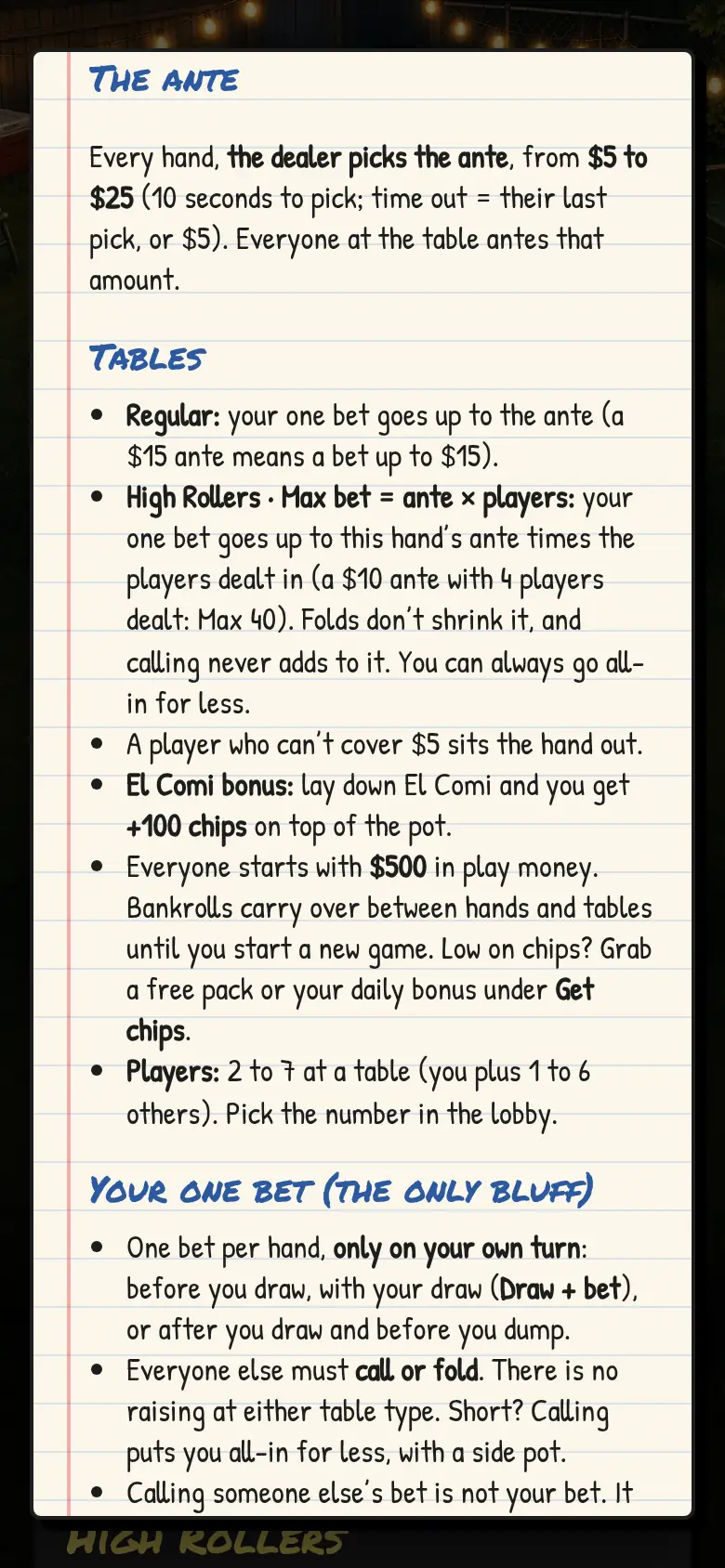
You get one bet per hand, on your own turn, and everyone else can only call or fold. Because the others cannot raise, your bet is a way to put pressure on the table, and it is the only bluff in the game. The most you can bet depends on the table type and the ante. A bet made when you are far from a win is a bluff, and a bet made when you are one card away is a value bet. Mix them up a little so players cannot read you. Calling a bet never uses up your own.
6. Treat chips as a way to keep score
Chips are play money: they have no cash value and never cash out. Treat them as a score. Keep your bets small while you are learning, so a few bad hands do not end your session, and practice at the tables with computer players before you join a live table.
7. Read the full rules once
A few details decide close hands: aces are high or low in straights but there is no wraparound, and three pair needs three different ranks. The rules page lists every house default.